Last reviewed: November 2026
Want to fill this in on your phone? We can add it to the app.
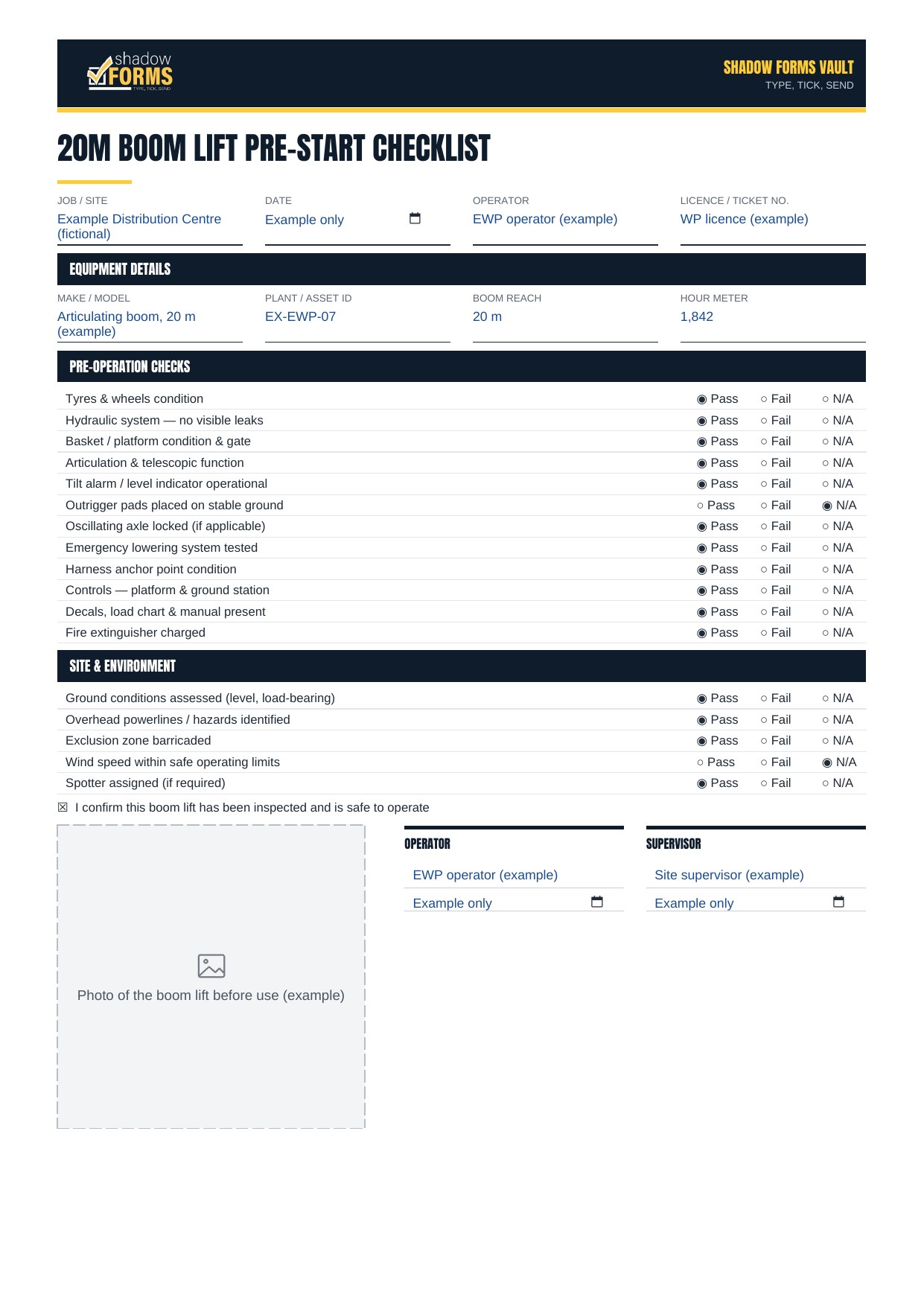
Upload a form →A boom lift pre-start checklist records that the machine, the site and the operator have been checked before the boom is used. Our free 20m boom lift pre-start checklist is a base template you fill in for your own machine and site. Below is an example of it filled in for a fictional distribution centre using a 20 m articulating boom indoors. Download the blank template here:
Using a scissor lift instead? See the EWP pre-start checklist.
The high risk work licence for booms of 11 m or more applies in every state and territory, but the codes and guidance behind it differ. We're not a regulator, so check yours:
New South Wales: NSW approved its own elevating work platforms code of practice from 10 July 2026. See SafeWork NSW's EWP code of practice
Victoria: Victoria has its own OHS laws. See WorkSafe Victoria
Queensland: inspection types and records are explained in WorkSafe Queensland's EWP maintenance and inspection page
Western Australia: see WorkSafe WA's boom-type EWP licence class
South Australia: SafeWork SA
Tasmania: WorkSafe Tasmania
Northern Territory: NT WorkSafe
Australian Capital Territory: WorkSafe ACT
Beyond the daily pre-start, EWPs also need routine, annual and major inspections. Follow the manufacturer's manual and AS 2550.10:2025
Every site is different, but these are boom lift hazards that often get missed, with the kind of control the pre-start should prompt for each:
Being crushed between the basket and a beam, ceiling or structure: plan the approach, move slowly near structures, and use secondary guarding if the machine has it.
Being thrown from the basket when the machine hits a pothole or kerb: check the travel path and keep the harness attached at all times.
Outriggers or wheels sinking into soft ground, pits or service covers: check the ground and use spreader plates where needed.
Overhead powerlines: identify them before set-up and keep the required approach distance, with a spotter where needed.
Wind and gusts at height: check the forecast and the manufacturer's wind limit, and come down if it's exceeded.
Overloading the basket with people, tools and materials: check the rated load on the plate and don't hang loads off the basket.
Climbing out of the basket at height: don't, unless it's a planned exit point with a documented procedure.
People walking under the boom: set an exclusion zone and keep it clear.
Before the boom goes up, check the pre-start doesn't have these gaps. Your site or hire company may look for more:
The operator's licence number isn't recorded, or it hasn't been sighted.
The whole sheet is ticked in one go, with no N/A for items that don't apply.
Emergency lowering is ticked but nobody on the ground knows how to use it.
Site checks are skipped because the machine passed.
A failed item is noted but the machine was used anyway, or nobody was told.
Example only, not for use as your own checklist. This is the base template filled in for a fictional job: a 20 m articulating boom used indoors at a distribution centre, so outriggers and wind are marked N/A. Click the page to enlarge it.
Your own checks must follow the manufacturer's manual for your machine. If anything fails, don't use it: park it safely, lock it out and tag it.
This form is in the Shadow Forms app. Your team can fill it in on site, add photos and sign it, then send it straight to the office.
The PDF and Word versions are copies only. If you have your own branded version, or want this one adjusted to your business, we can add it to the app. Upload a form, or get in touch.
Using a scissor lift? Get the free EWP pre-start checklist.
Using a forklift? Get the free forklift pre-start checklist.
Safe Work Australia's EWP code says yes. A boom-type EWP with a boom of 11 m or more needs a high risk work licence, and the licence should be sighted and recorded before work starts.
WorkSafe Queensland says it's the greater of the vertical reach to the platform floor or the horizontal reach from the centre of rotation. The EWP code uses the same approach, based on the machine's original design.
Before each use or shift, following the manufacturer's manual and your site's rules. Many sites also re-check whenever the operator changes.
Safe Work Australia's EWP code says yes. People on the platform of a boom-type EWP must wear a full harness attached to the designated anchor point.
Yes. It's already in the Shadow Forms app. If you have your own branded version, or want this one adjusted to your business, upload it on our Upload a form page or get in touch.
General information only, not legal advice. Check your state or territory regulator.
Send us your own forms and we'll show you exactly how they'd work in the app, no obligation.
Questions? Email us at info@neonroom.com.au