Last reviewed: November 2026
Want to fill this in on your phone? We can add it to the app.
Upload a form →An EWP pre-start checklist records that an elevating work platform, such as a scissor lift, and the work area were checked before use. Our free EWP pre-start checklist is a base template you fill in for your own machine and site. Below is an example of it filled in for a fictional contractor using an 8 m scissor lift in a food plant. Download the blank template here:
Using a boom lift? See the boom lift pre-start checklist.
Scissor lifts don't need a high risk work licence anywhere, but operators must be trained, and states publish their own codes and lessons from incidents. We're not a regulator, so check yours:
New South Wales: NSW approved its own elevating work platforms code of practice from 10 July 2026. See SafeWork NSW's EWP code of practice
New South Wales: two scissor lift tip-overs, caused by drilling force and a dropped load, are covered in SafeWork NSW's mobile elevating platform tip-overs release
Victoria: Victoria has its own OHS laws. See WorkSafe Victoria
Queensland: pre-start, routine, annual and major inspections, and how long to keep records, are set out in WorkSafe Queensland's EWP inspection page
Western Australia: an EWP that tipped when a wheel left the kerb is covered in WorkSafe WA's all-terrain EWP incident alert
South Australia: SafeWork SA
Tasmania: WorkSafe Tasmania
Northern Territory: NT WorkSafe
Australian Capital Territory: WorkSafe ACT
The national guidance is Safe Work Australia's EWP code of practice
Every site is different, but these are scissor lift hazards that often get missed, with the kind of control the pre-start should prompt for each:
Pushing or pulling hard from the platform, such as drilling, screwing or prying: check the manual side force on the compliance plate and stay within it.
Dropping or lowering heavy items over the rails: bring materials down another way, and don't let loads land on the handrail.
Using an indoor-rated machine outdoors: check the plate, and don't take an indoor-only scissor lift outside.
Wind on outdoor-rated machines: check the rated wind speed on the plate and stop work if it's exceeded.
Driving while raised over cracks, kerbs, ramps or drains: check the travel path and lower before crossing uneven ground.
Floor loading on suspended slabs, mezzanines or over pits: confirm the floor can take the machine's weight before driving onto it.
Standing on the guardrails or mid-rail to reach higher: get a taller machine instead.
Charging batteries: charge in a ventilated area away from ignition sources, and check cables and plugs.
Before you go up, check the pre-start doesn't have these gaps. Your hire company or principal contractor may look for more:
The machine isn't identified, so the check can't be matched to a fleet number or hire docket.
It doesn't say whether the machine is rated for indoor or outdoor use.
The logbook isn't checked, so overdue routine or annual inspections are missed.
The operator's training or familiarisation on that model isn't recorded.
Faults are written in the comments but the machine isn't tagged out.
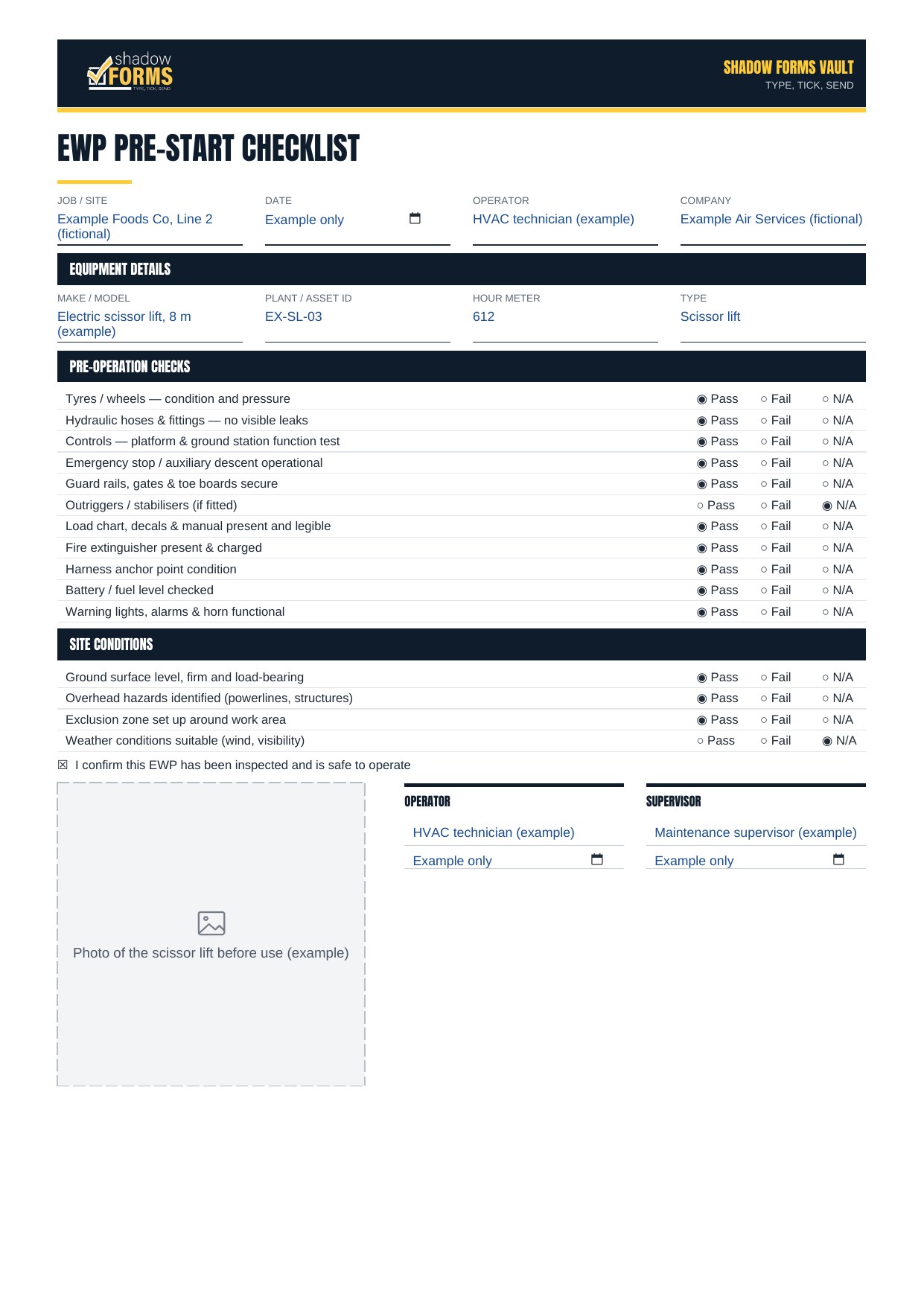
Example only, not for use as your own checklist. This is the base template filled in for a fictional job: a contractor using an 8 m electric scissor lift indoors at a food plant, so outriggers and weather are marked N/A. Click the page to enlarge it.
Your own checks must follow the manufacturer's manual for your machine. If anything fails, don't use it: park it safely, lock it out and tag it.
This form is in the Shadow Forms app. Your team can fill it in on site, add photos and sign it, then send it straight to the office.
The PDF and Word versions are copies only. If you have your own branded version, or want this one adjusted to your business, we can add it to the app. Upload a form, or get in touch.
Using a boom lift? Get the free boom lift pre-start checklist.
Checking machine guards? Get the free machine guarding inspection checklist.
Safe Work Australia's EWP code says the high risk work licence applies to boom-type EWPs with a boom of 11 m or more, so a scissor lift doesn't need one. Operators must still be trained for the machine they use.
The EWP code describes scissor lifts as moving straight up and down on a criss-cross mechanism, while boom lifts reach up and over obstacles. Booms of 11 m or more need a licence, as WorkSafe Queensland explains.
Only if your risk assessment says so, according to Safe Work Australia's EWP code. Boom-type EWPs are different: a harness attached to the anchor point is required.
Safe Work Australia's EWP code says not to use it. Park it in a safe area, lock it out and tag it so no one else can use it, and report the fault.
Yes. It's already in the Shadow Forms app. If you have your own branded version, or want this one adjusted to your business, upload it on our Upload a form page or get in touch.
General information only, not legal advice. Check your state or territory regulator.
Send us your own forms and we'll show you exactly how they'd work in the app, no obligation.
Questions? Email us at info@neonroom.com.au