Last reviewed: November 2026
Want to fill this in on your phone? We can add it to the app.
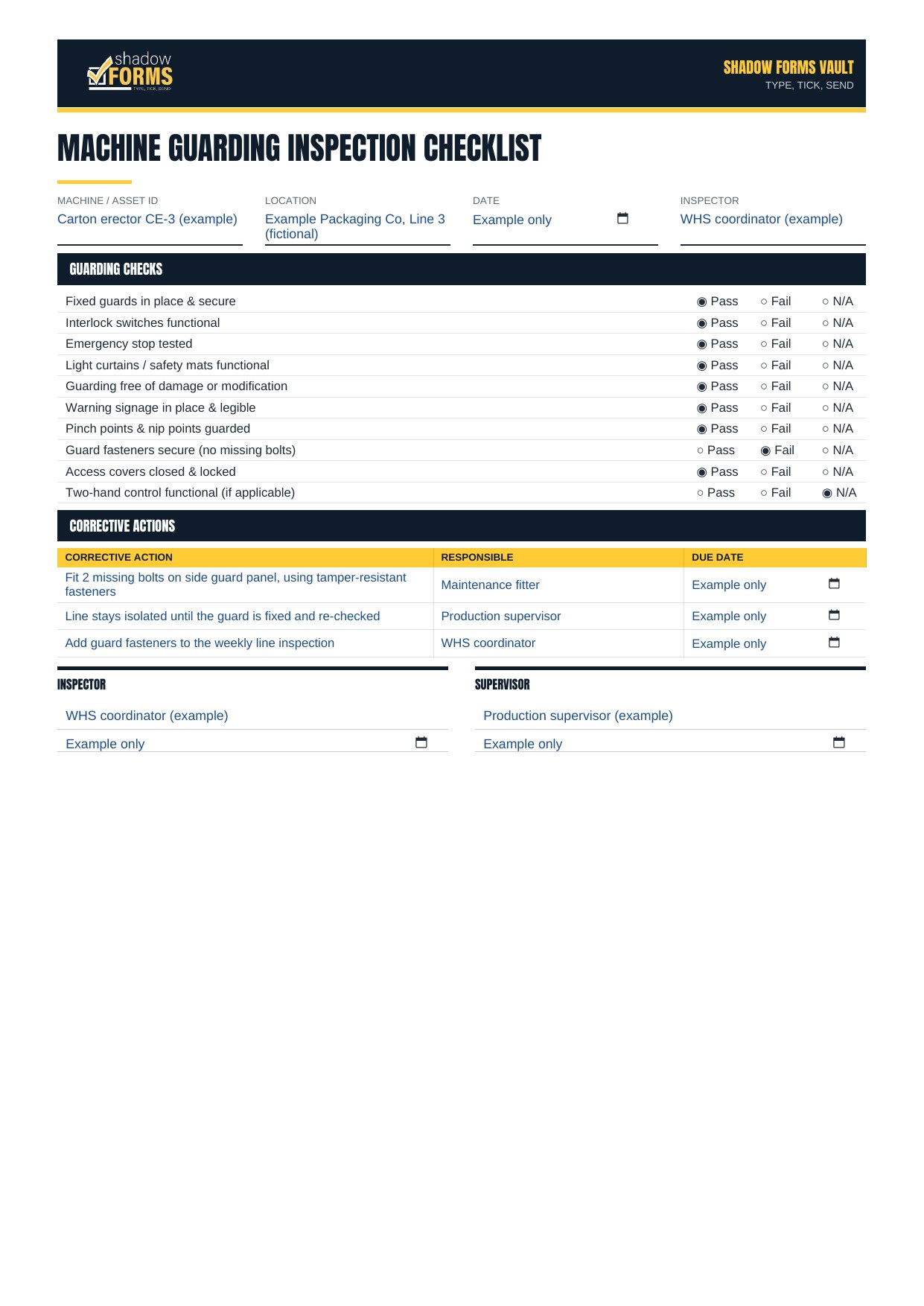
Upload a form →A machine guarding inspection checklist records that the guards, interlocks and emergency stops on a machine are in place and working, and what needs fixing. Our free machine guarding inspection checklist is a base template you fill in for your own machines. Below is an example of it filled in for a fictional carton erector, with a failed check and the corrective actions that followed. Download the blank template here:
Removing a guard for maintenance? Isolate the machine first with a lockout tagout permit.
Every state requires dangerous machine parts to be guarded, but each regulator publishes its own guidance and tools. We're not a regulator, so check yours:
New South Wales: SafeWork NSW's guide to machine safety
New South Wales: to check your own site, try SafeWork NSW's machine safety self-assessment tool
Victoria: Victoria has its own OHS laws, which set out the guarding hierarchy. See WorkSafe Victoria's compliance code: Plant
Western Australia: WorkSafe WA's guarding page
Queensland: WorkSafe Queensland
South Australia: SafeWork SA
Tasmania: WorkSafe Tasmania
Northern Territory: NT WorkSafe
Australian Capital Territory: WorkSafe ACT
The national guidance is Safe Work Australia's plant code
Every machine is different, but these are guarding problems that often get missed, with the kind of action the inspection should record for each:
Guards taken off for cleaning or a jam and not put back: check after every clean and changeover, not just on inspection day.
Interlocks bypassed with tape, magnets, cable ties or a spare key: test each interlock stops the machine, and look for signs of tampering.
Light curtains or sensors moved, re-angled or with dirty lenses: check they still cover the danger zone and stop the machine in time.
Gaps big enough to reach through, over or under a guard: check reach distances, especially after guards are modified or panels replaced.
Parts that keep moving after the stop button is pressed: check run-down time, and that guards stay locked until motion stops where needed.
Unguarded nip points on conveyors, rollers and pulleys, especially tail and return ends: check every drive and return point, not just the infeed.
Machines that were modified, moved or bought second-hand: re-check the guarding against the machine as it is now, not the original manual.
Relying on the e-stop or a closed guard while working inside the machine: they aren't isolation, so lock it out first.
Before you sign off, check the inspection doesn't have these gaps. Your site's procedure may ask for more:
Interlocks and e-stops are ticked by looking, not tested by operating them.
It covers the operator's side only, not the back, sides and top of the machine.
A failed item has no corrective action, owner or due date.
There's no record of whether the machine was taken out of service until it was fixed.
Nobody checks the fix later, so the item is never closed out.
Example only, not for use as your own checklist. This is the base template filled in for a fictional carton erector with two bolts missing from a side guard, and the corrective actions that followed. Click the page to enlarge it.
Your own inspection must cover the actual guarding on your machine. Follow the manufacturer's instructions and your site's procedures.
This form is in the Shadow Forms app. Your team can fill it in on site, add photos and sign it, then send it straight to the office.
The PDF and Word versions are copies only. If you have your own branded version, or want this one adjusted to your business, we can add it to the app. Upload a form, or get in touch.
Isolating a machine for repairs? Get the free lockout tagout permit template.
Checking a forklift? Get the free forklift pre-start checklist.
Safe Work Australia's plant code says guards must be regularly inspected and tested. Set how often from the manufacturer's advice, how much the machine is used, and any past problems.
Safe Work Australia's plant code puts a permanently fixed barrier first, where no access is needed. Where access is needed, an interlocked guard comes next. The code explains the full order of preference.
Not usually. A pre-start is done before each use. A guarding inspection is a more detailed check done on a regular schedule, though operators should still check guards are in place before starting a machine.
Safe Work Australia's plant code says guarding should be as hard as possible to bypass. If you find one bypassed, stop and isolate the machine, then fix both the guard and the reason it was bypassed.
Yes. It's already in the Shadow Forms app. If you have your own branded version, or want this one adjusted to your business, upload it on our Upload a form page or get in touch.
General information only, not legal advice. Check your state or territory regulator.
Send us your own forms and we'll show you exactly how they'd work in the app, no obligation.
Questions? Email us at info@neonroom.com.au