Last reviewed: November 2026
Want to fill this in on your phone? We can add it to the app.
Upload a form →A non-conformance report (NCR) records when a product, process or service doesn't meet its requirements, what you did with it, and how you'll stop it happening again. Our free NCR template is a base template you fill in for your own business. Below is an example of it filled in for a fictional batch of brackets with holes cut in the wrong position. Download the blank template here:
Most NCRs stay in-house, but some defects trigger legal reporting duties, with short deadlines. We're not a regulator, so check what applies to your products:
Consumer products: if a product you supplied is linked to a death, serious injury or serious illness, suppliers must report it to the ACCC within 2 days of becoming aware. See the ACCC's mandatory reporting page
Building products in Queensland: designers, manufacturers, importers and suppliers must report a suspected non-conforming building product to the QBCC as soon as practicable, and within 2 days. See the QBCC's guide for manufacturers and suppliers
Worker injuries: if a defect injures someone at work, it may also be a notifiable incident. See Safe Work Australia's incident notification guidance
Other states have their own building product rules, and your customer contract may set its own notification times, so check both.
Every NCR is different, but these are traps that often let the same problem come back, with a way around each:
Quarantine on paper only: physically separate and tag the product so it can't be picked, used or shipped by mistake.
Only checking the batch you found: check other batches, stock on hand and anything already shipped that could have the same fault.
"Use as is" without the right approval: get sign-off from the customer or designer where your contract or specification requires it.
Rework that isn't re-inspected: inspect reworked items against the original requirement before they're released.
Supplier faults handled internally: send the NCR to the supplier and ask for their corrective action.
Fixing the part, not the process: find the root cause, such as an old drawing revision, worn tooling or unclear instructions.
Repeat NCRs that nobody notices: review NCRs by product, supplier and cause, so patterns show up.
A quality defect that's also a safety risk: run it through your incident and risk process too, not just the NCR.
Before you close an NCR, check it doesn't have these gaps. Your customer or certification body may look for more:
The description doesn't say what the requirement was, so it's unclear how far out it is.
The quantity affected is missing, or only counts what was found, not what was made.
The disposition isn't recorded, or nobody approved it.
The root cause is "operator error" with no system cause behind it.
It's closed without checking the corrective action worked.
Example only, not for use as your own report. This is the base template filled in for a fictional issue: 36 laser-cut brackets with holes 3 mm out of position, because an old drawing revision was used. Click the page to enlarge it.
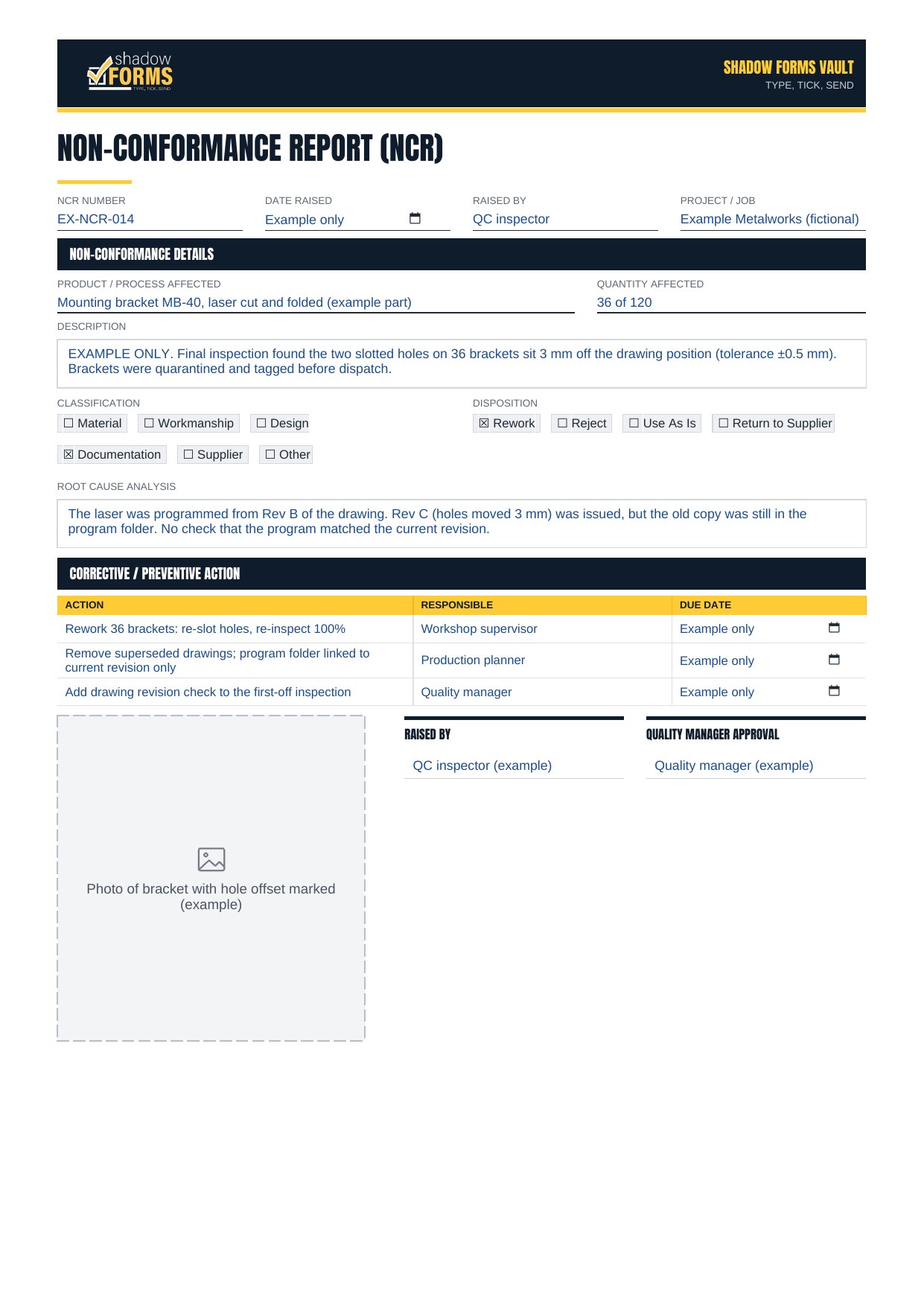
Your own NCR must describe the actual issue. A "use as is" decision may need your customer's or designer's approval, so check your contract.
This form is in the Shadow Forms app. Your team can fill it in on site, add photos and sign it, then send it straight to the office.
The PDF and Word versions are copies only. If you have your own branded version, or want this one adjusted to your business, we can add it to the app. Upload a form, or get in touch.
Need to dig deeper into the cause? Get the free root cause analysis template.
Have contractors on site? Get the free contractor induction template.
ISO 9001 is a voluntary standard, so an NCR isn't a legal requirement in itself. If you're certified, or a customer contract requires it, you'll need a way to record nonconformities and corrective action.
ISO published ISO 9001:2026 on 16 September 2026, with clearer wording and more focus on leadership, quality culture and risk. Certified businesses have until 30 September 2029 to transition. See the ISO 9001 page for details.
Corrective action fixes the cause of a problem that has happened, so it doesn't happen again. Preventive action deals with a problem that could happen. This form records both.
ISO 9001 allows nonconforming product to be accepted under concession, but only with authorisation, which may need to come from your customer. Record who approved it on the NCR.
Yes. It's already in the Shadow Forms app. If you have your own branded version, or want this one adjusted to your business, upload it on our Upload a form page or get in touch.
General information only, not legal or certification advice. Check with your certification body or regulator.
Send us your own forms and we'll show you exactly how they'd work in the app, no obligation.
Questions? Email us at info@neonroom.com.au