Last reviewed: November 2026
Want to fill this in on your phone? We can add it to the app.
Upload a form →A root cause analysis looks past what went wrong to why it went wrong, so the same incident or near miss doesn't happen again. Our free root cause analysis template is a base template you fill in for your own incident. Below is an example of it filled in for a fictional incident on a packaging line, so you can see how to work back from the problem to the cause. Download the blank template here:
Need to record the incident itself first? Get the free incident report template.
If the incident is notifiable, tell your regulator before you start the analysis. How you notify differs between states. We're not a regulator, so check yours:
New South Wales: call SafeWork NSW immediately on 13 10 50, 24 hours a day. Separately, notify your workers compensation insurer within 48 hours of a workplace injury. See SafeWork NSW's incident notification page
Victoria: call WorkSafe immediately on 13 23 60, then send written notice within 48 hours and keep a copy for at least 5 years. Notification rules for some plant and equipment incidents changed from 1 July 2024. See WorkSafe Victoria's report an incident page
Queensland: WorkSafe Queensland
South Australia: SafeWork SA
Western Australia: WorkSafe WA
Tasmania: WorkSafe Tasmania
Northern Territory: NT WorkSafe
Australian Capital Territory: WorkSafe ACT
After a notifiable incident, leave the scene undisturbed until the regulator says otherwise, except to help the injured or make the area safe.
Every incident is different, but these are traps that often stop a root cause analysis from finding the real cause, with a way around each:
Stopping at "the worker didn't follow the procedure": ask why it wasn't followed. Was it unclear, impractical, or never trained?
Looking for one cause when there were several: list every contributing factor, then pick the ones that would have stopped it.
Starting the analysis days later: collect photos, statements and records while they're fresh.
Only talking to supervisors: include the person who does the task, and anyone who saw it happen.
Corrective actions that are just more training or a reminder: aim higher on the hierarchy of control, such as removing or engineering out the hazard.
Not checking for the same problem elsewhere: look at similar machines, shifts or sites that could have the same gap.
Treating near misses as not worth the effort: a near miss with serious potential deserves the same analysis as an injury.
Blaming people: people are more open about what happened when the aim is fixing systems, not finding fault.
Before you sign it off, check the analysis doesn't have these gaps. Your site's investigation procedure may ask for more:
The problem statement is vague, such as "injury on line 2", with no what, where or when.
The 5 Whys stop after one or two answers.
The root cause is a person, not a system or condition you can change.
Actions have no owner or due date, or say "ongoing".
Nobody checks later whether the actions worked, so the record is never closed.
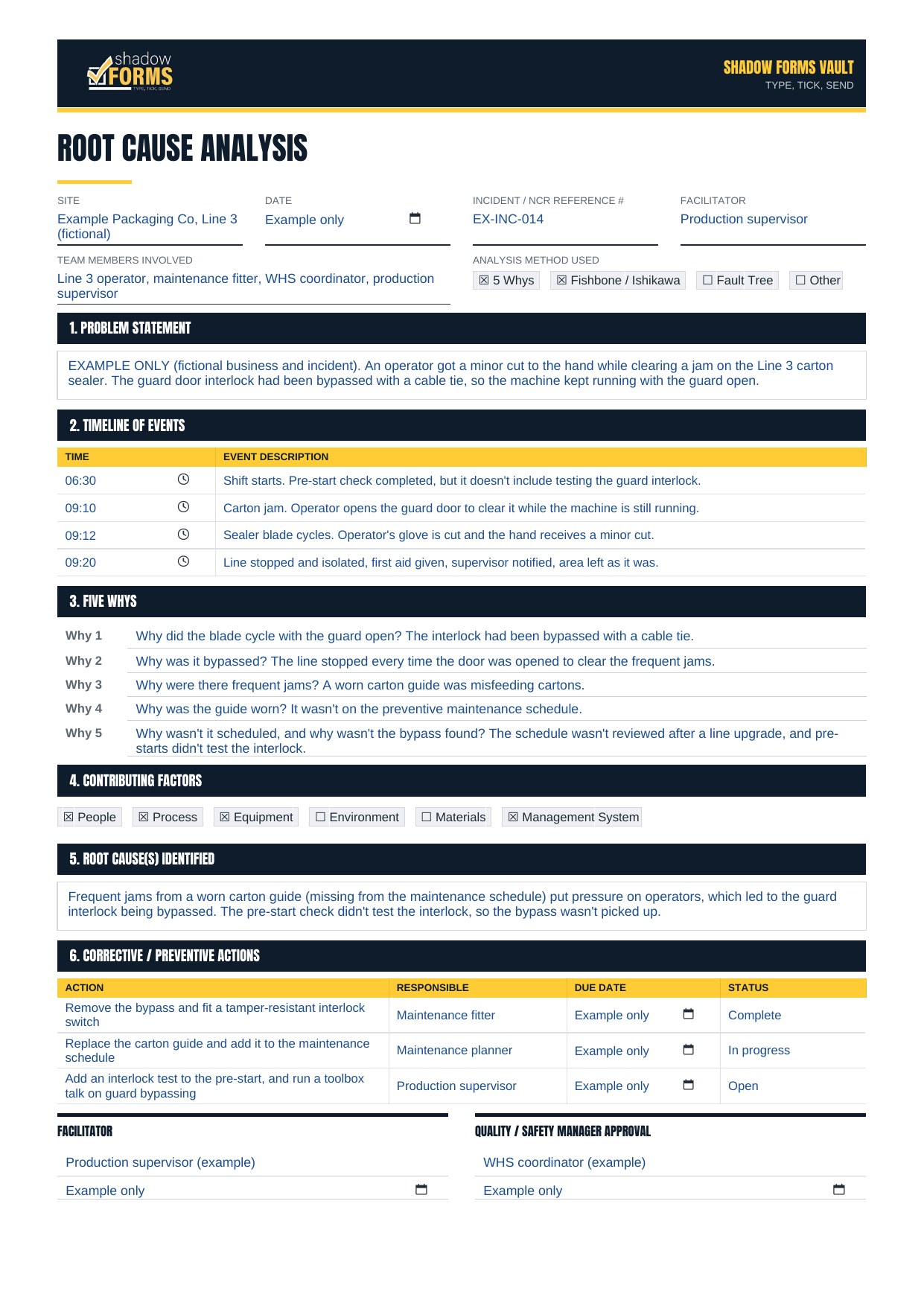
Example only, not for use as your own analysis. This is the base template filled in for a fictional incident: an operator cut on a carton sealer after a guard interlock was bypassed. Click the page to enlarge it.
Your own analysis must be based on the facts of your incident and site. Track each action until it's done, and check that it worked.
This form is in the Shadow Forms app. Your team can fill it in on site, add photos and sign it, then send it straight to the office.
The PDF and Word versions are copies only. If you have your own branded version, or want this one adjusted to your business, we can add it to the app. Upload a form, or get in touch.
Recording a quality issue instead? Get the free non-conformance report template.
Cleaning up after a chemical spill? Get the free chemical spill report template.
Safe Work Australia says you should review your controls after an incident, but no law requires a specific form or method. Check your regulator for what's expected where you work.
Safe Work Australia says notifiable incidents, such as a death, serious injury or illness, or a dangerous incident, must be reported immediately. Its notification handbook also says to keep a record of each notifiable incident for 5 years.
5 Whys keeps asking why until you reach a cause you can fix. A fishbone (Ishikawa) diagram sorts possible causes into groups like people, equipment and process. Many teams use both, as in the example above.
Safe Work Australia says workers must be consulted on health and safety matters. Include a supervisor, someone who does the task, and someone with maintenance or technical knowledge where it helps.
Yes. It's already in the Shadow Forms app. If you have your own branded version, or want this one adjusted to your business, upload it on our Upload a form page or get in touch.
General information only, not legal advice. Check your state or territory regulator.
Send us your own forms and we'll show you exactly how they'd work in the app, no obligation.
Questions? Email us at info@neonroom.com.au