Last reviewed: November 2026
Want to fill this in on your phone? We can add it to the app.
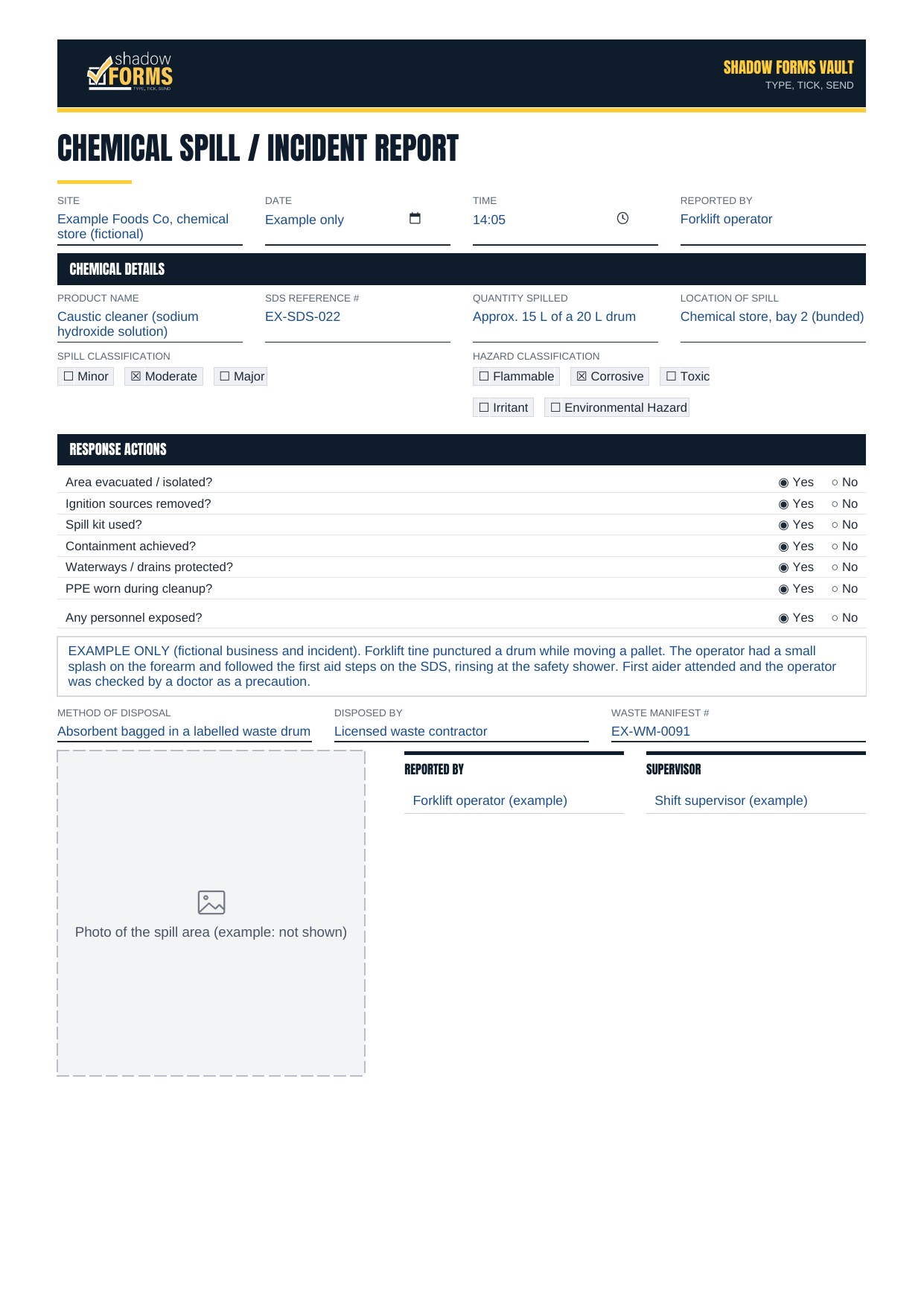
Upload a form →A chemical spill report records what was spilled, how it was contained and cleaned up, who was exposed, and how the waste was disposed of. Our free chemical spill report template is a base template you fill in for your own site. Below is an example of it filled in for a fictional spill of caustic cleaner in a food plant's chemical store. Download the blank template here:
Did someone get hurt? Also fill in the free incident report template.
A spill can need reporting to two regulators: your WHS regulator if someone was exposed to a serious risk, and your environment regulator if it could cause pollution. We're not a regulator, so check both:
New South Wales: pollution incidents that cause or threaten material harm must be notified immediately under section 148 of the POEO Act. See NSW EPA's duty to notify pollution incidents
New South Wales: for WHS notification, see SafeWork NSW's incident notification page
Victoria: a leak, spill or escape that causes or is likely to cause material harm, including clean-up costs of $10,000 or more, must be notified to EPA Victoria as soon as practicable. See EPA Victoria's duty to notify page
Victoria: for WHS notification, see WorkSafe Victoria's report an incident page
Queensland: WorkSafe Queensland
South Australia: SafeWork SA
Western Australia: WorkSafe WA
Tasmania: WorkSafe Tasmania
Northern Territory: NT WorkSafe
Australian Capital Territory: WorkSafe ACT
Outside NSW and Victoria, check your state's environment protection authority as well as your WHS regulator.
Every spill is different, but these are hazards that often get missed during the response, with the kind of control the report should show for each:
Not knowing what was spilled: check the label and SDS before anyone goes near it, and keep people back until you do.
Chemicals reacting with each other, such as acids and alkalis, or oxidisers and fuels: keep incompatible products apart, and don't mix spills together.
Using the wrong absorbent, such as sawdust or rags on an oxidiser: use the absorbent the SDS or spill kit specifies.
Spills reaching stormwater or sewer drains: cover drains first, and check where floor drains actually go.
Flammable vapours: remove ignition sources, ventilate, and keep vehicles and forklifts away from the area.
Fumes and skin contact for the people cleaning up: wear the PPE on the SDS, and stop and call for help if it's beyond your training.
Contaminated waste and PPE: bag, label and store it separately, and use a licensed waste contractor where needed.
An empty or incomplete spill kit next time: restock it straight after use and record that it was done.
Before you close the report, check it doesn't have these gaps. Your site or environment licence may ask for more:
The product is named by its trade name only, with no SDS or hazard class.
The quantity is a guess with no basis, such as "some" or "a bit".
It doesn't say whether anything reached a drain, soil or waterway.
Nobody decided whether the spill was notifiable to either regulator, or the decision isn't recorded.
The cause isn't recorded, so the same spill happens again.
Example only, not for use as your own report. This is the base template filled in for a fictional spill: a forklift punctured a drum of caustic cleaner in a bunded chemical store. Click the page to enlarge it.
Always follow the SDS and your site's emergency plan. Your own report must describe what actually happened on your site.
This form is in the Shadow Forms app. Your team can fill it in on site, add photos and sign it, then send it straight to the office.
The PDF and Word versions are copies only. If you have your own branded version, or want this one adjusted to your business, we can add it to the app. Upload a form, or get in touch.
Want to find out why the spill happened? Get the free root cause analysis template.
Have contractors on site? Get the free contractor induction template.
Safe Work Australia lists an uncontrolled spill or leak of a substance as a dangerous incident, which must be notified to your WHS regulator immediately if it exposes someone to a serious risk. Your environment regulator may need to know too.
EPA Victoria says to notify spills that cause or could cause material harm, even when they're contained on site. The NSW EPA has its own duty to notify pollution incidents. Check with the EPA in your state or territory.
It depends on the chemicals you have. Check each product's SDS, and match the absorbents, neutralisers, PPE and drain covers to what you store and use.
Safe Work Australia's hazardous chemicals code covers emergency plans for hazardous chemicals. Only people trained in your spill procedure, wearing the right PPE, should clean up. For a large or unknown spill, evacuate and call 000.
Yes. It's already in the Shadow Forms app. If you have your own branded version, or want this one adjusted to your business, upload it on our Upload a form page or get in touch.
General information only, not legal advice. Check your state or territory regulator.
Send us your own forms and we'll show you exactly how they'd work in the app, no obligation.
Questions? Email us at info@neonroom.com.au