Free Template

Free Working at Heights SWMS Template (with Example)

Working at heights is one of the most common reasons a Safe Work Method Statement is needed. Download the free SWMS template below, then read on for a filled-in working at heights example, the hazards to cover and the fall controls to think about.

When working at heights needs a SWMS

  • Safe Work Australia says construction work with a risk of a person falling more than 2 metres is high risk construction work, and a SWMS must be prepared before that work starts.
  • The height threshold can differ by state or territory. SafeWork SA, for example, says it lowered its threshold from 3 metres to 2 metres from 1 July 2026. Check your own regulator.
  • A SWMS should be specific to the job, the site and how the work will be done. Your principal contractor may have extra requirements.

Not sure whether your job needs a SWMS? Read what a SWMS is and when it's required.

Fall controls to think about

  • Safe Work Australia's approach to falls starts with eliminating the risk where reasonably practicable, for example by doing the work on the ground or on a solid construction.
  • Where that isn't practicable, it points to fall prevention devices such as barriers, scaffolding, edge protection or elevating work platforms, then work positioning systems, then fall arrest systems such as safety nets or catch platforms.
  • More than one control may be needed, and controls should be reviewed to check they work. Your SWMS should show which controls you will use for each work step.

What to include in a working at heights SWMS

  • The work at height being done, where, and how high
  • Each work step, such as setting up, getting to the work area, doing the work and packing down
  • The fall hazards at each step: edges, openings, fragile surfaces, ladders and access points
  • Hazards from falling objects, and how people below are protected
  • The fall controls, equipment and PPE, and who is responsible for each
  • Emergency and rescue procedures, and sign-off from everyone on the job

Filled-in working at heights SWMS example

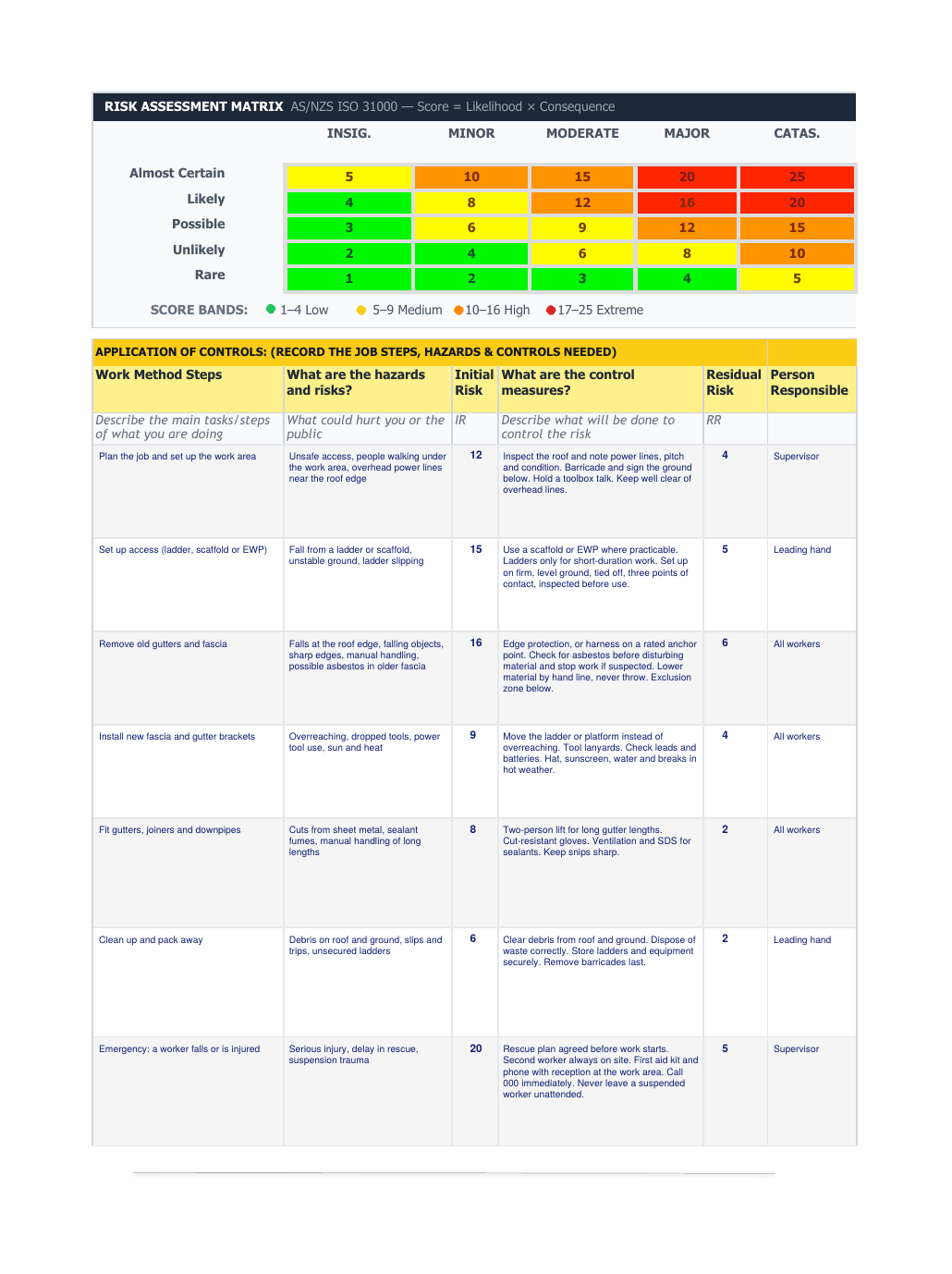
Example only, not for use as your own SWMS. This is the free template filled in for a gutter and fascia replacement on a single-storey house, a common working at heights job. Click a page to enlarge it.
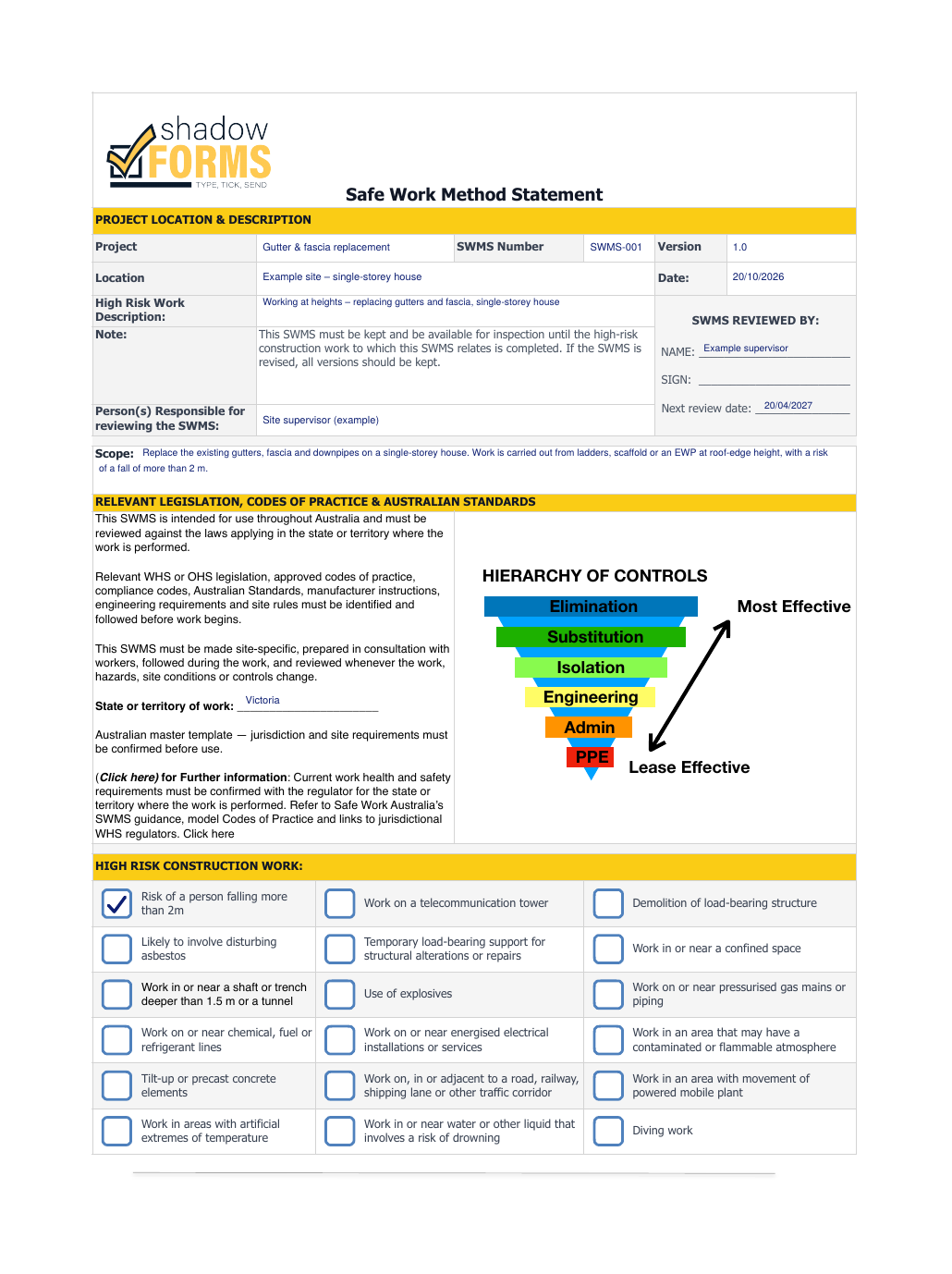
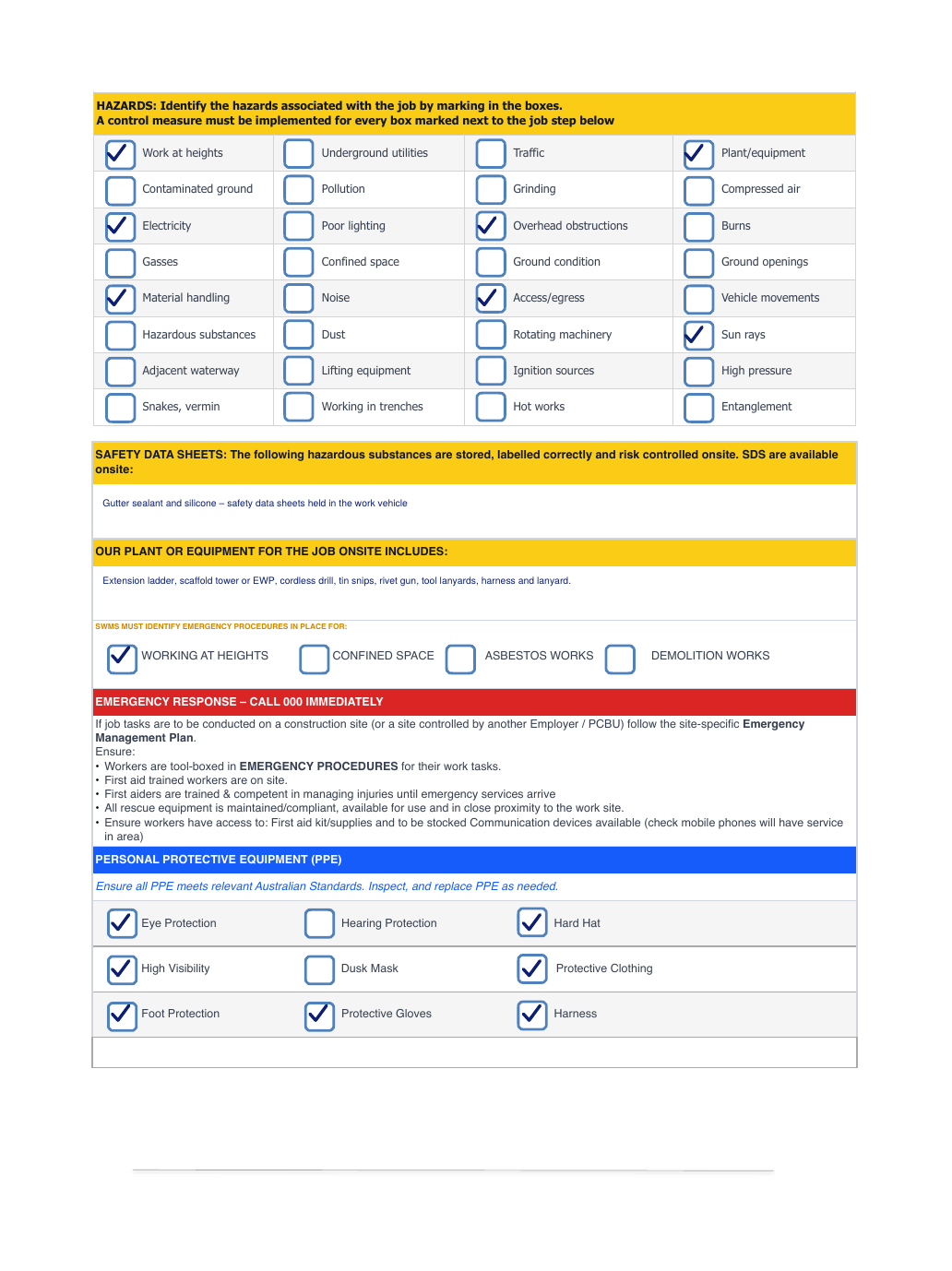
Your own SWMS must be specific to your job and site, and prepared in consultation with the workers doing the work.

How to fill one in for work at height

  1. Describe the work at height, the location and how high you will be working.
  2. Tick the high risk construction work and the hazards that apply, including the risk of a fall.
  3. List each work step in order, from setting up access to packing down, with its fall hazards.
  4. Write the fall controls for each step and who is responsible, and rate the risk before and after the controls.
  5. Have everyone on the job read and sign it before work starts.

Build your working at heights SWMS online, or get it into the app

The Shadow Forms SWMS builder is a tool on our website that guides you step by step through creating a SWMS for your job, including work at height. Enter your email address and you can download it as a PDF.

The PDF is a copy only. To complete it digitally, upload it and we can add it to the app, Shadow Forms branded. If you have your own uniquely branded SWMS, or want this example adjusted to your business, we can do that too. Upload a form, or get in touch.

Need a JSA instead? Try the free JSA template.

Just need a quick check before you start? Get the free Take 5 template.

Frequently asked questions

Do I need a SWMS for working at heights?

Safe Work Australia says construction work with a risk of falling more than 2 metres is high risk construction work, and a SWMS must be prepared before it starts. Thresholds can differ by state, so check your regulator.

What height needs a SWMS?

Safe Work Australia uses a risk of falling more than 2 metres. SafeWork SA says it lowered its threshold from 3 metres to 2 metres from 1 July 2026. Check what applies in your state or territory.

Can I use a generic SWMS for working at heights?

Yes, as a starting point. It must be made specific to the actual job and site, and prepared in consultation with workers, before work starts.

What fall controls should a SWMS include?

Safe Work Australia's approach starts with eliminating the risk where practicable, then fall prevention devices, work positioning systems and fall arrest systems. Choose the controls that suit the job, and check that they work.

Can I turn my working at heights SWMS into a digital form?

Yes. Upload it on our Upload a form page and we can add your SWMS to the app. A SWMS from the builder would be Shadow Forms branded. If you have your own branded SWMS, or want this example adjusted to your business, get in touch.

General information only, not legal advice. Check your state or territory regulator.

Need a working at heights SWMS drafted?

Use our SWMS builder, or send us your own SWMS and we'll show you exactly how it would work in the app, no obligation.

Questions? Email us at info@neonroom.com.au

Shadow Forms
Ask us anything