Last reviewed: November 2026
Want to fill this in on your phone? We can add it to the app.
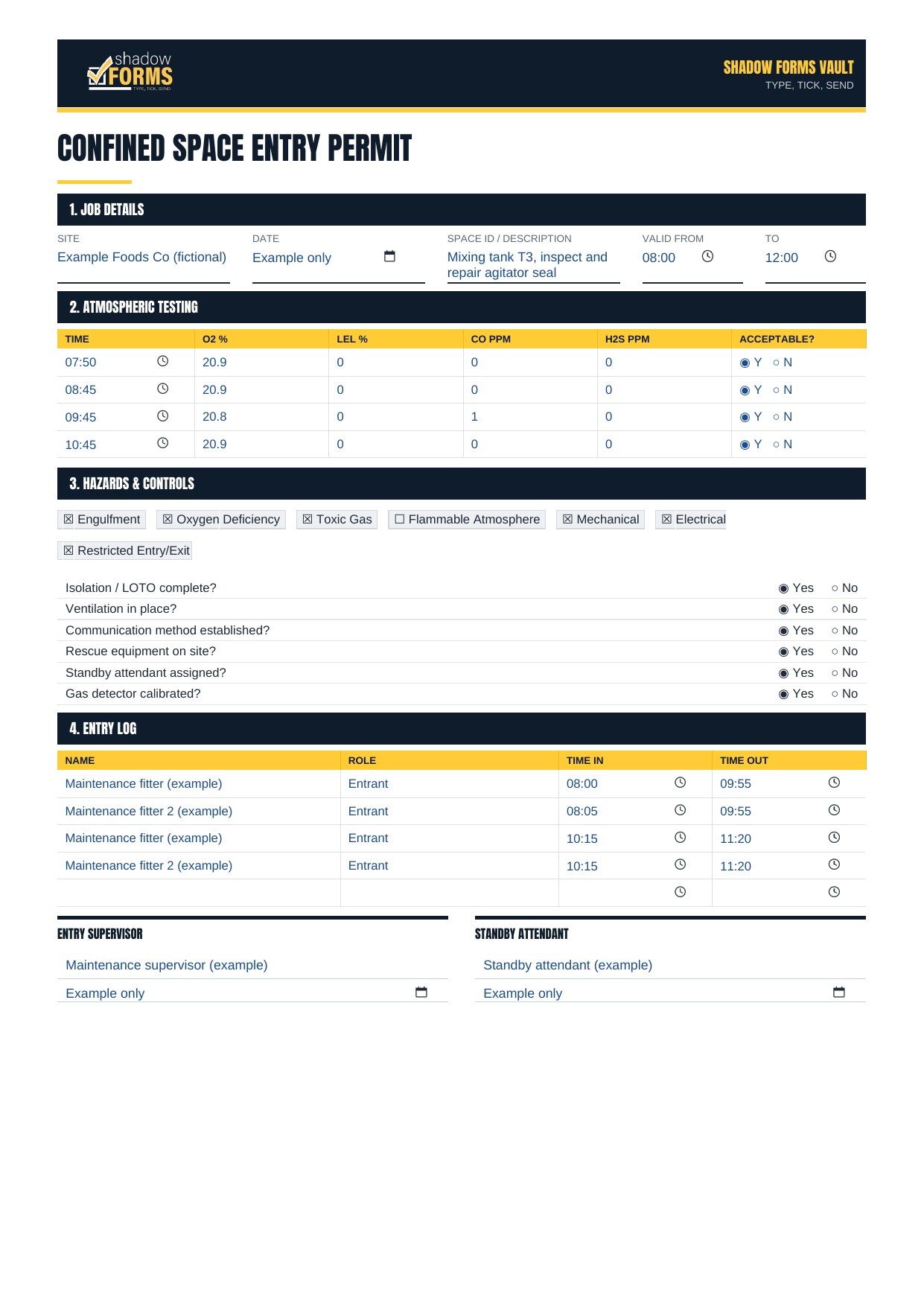
Upload a form →A confined space entry permit must be completed in writing before anyone enters a confined space. It records the space, the gas tests, the hazards and controls, who went in and out, and sign-off by the entry supervisor and standby attendant. Our free confined space entry permit template is a base template you fill in for your own site. Below is an example of it filled in for a fictional tank entry at a food plant. Download the blank template here:
Need a SWMS for the work too? See the confined space SWMS example.
Every state requires a written entry permit, but several states and territories have their own confined spaces code that sets out what goes on it. We're not a regulator, so check yours:
Victoria: the entry permit requirement sits in the state's OHS Regulations. See WorkSafe Victoria's compliance code: Confined spaces
Queensland: WorkSafe Queensland's Confined spaces Code of Practice 2021
Western Australia: WorkSafe WA's confined spaces code of practice
Australian Capital Territory: an updated code was approved in 2025. See the ACT approval notice
Northern Territory: NT WorkSafe's confined spaces code
New South Wales: SafeWork NSW
South Australia: SafeWork SA
Tasmania: WorkSafe Tasmania
The national model code is Safe Work Australia's confined spaces code of practice
A permit records conditions at the start, but a confined space can change during the job. These are the changes that often get missed, with the kind of control the permit should show for each:
Gas layering: heavier gases such as hydrogen sulphide sit low and lighter ones such as methane sit high. Test at the top, middle and bottom, not just at the opening.
A detector that isn't reading properly: bump test it before use, check its calibration date, and record the detector ID on the permit.
The work itself changing the air, such as welding, coatings, cleaning chemicals or disturbed sludge: keep monitoring and re-test after each change.
Rain, process flows or a valve opened elsewhere on site: confirm inflows are blanked or locked out, and watch the weather.
The standby attendant called away or swapped over: name a replacement on the permit before the first person leaves.
Losing contact with the people inside: agree how you'll communicate, test it before entry, and set a regular check-in.
Heat and fatigue building up over time: set maximum times inside and rest breaks on the permit.
A long break or shift change: re-test the atmosphere and re-check controls before anyone goes back in.
Before anyone goes in, check the permit doesn't have these gaps. Your site's confined space procedure may ask for more:
Gas readings are recorded without a time, where they were taken, or which detector was used.
The entry log doesn't match who's actually inside, or nobody signs out.
The rescue equipment is ticked but nobody has checked it's set up at the opening.
The permit is still open from yesterday, or was never closed once everyone was out.
The permit doesn't name the person who issued it, or they aren't competent for that space.
Example only, not for use as your own permit. This is the base template filled in for a fictional job: two fitters entering a mixing tank to repair the agitator seal. Click the page to enlarge it.
Your own permit must be completed by a competent person for your actual space and job. Keep it until the work is done, or for at least 2 years if there's a notifiable incident.
This form is in the Shadow Forms app. Your team can fill it in on site, add photos and sign it, then send it straight to the office.
The PDF and Word versions are copies only. If you have your own branded version, or want this one adjusted to your business, we can add it to the app. Upload a form, or get in touch.
Isolating plant before entry? Get the free lockout tagout permit template.
Running a bigger job? Get the free permit to work template.
Safe Work Australia's confined spaces code says yes: a written entry permit is needed before anyone enters a confined space. Check your state or territory regulator for the exact rules.
Safe Work Australia's code says to keep it until the work is done, or for at least 2 years if there's a notifiable incident. Our confined space SWMS example covers the rest of the paperwork for the job.
They stay outside the space, keep in contact with the people inside, watch the conditions, and raise the alarm and start a rescue from outside if something goes wrong. They shouldn't go in.
Safe Work Australia's confined spaces code sets oxygen between 19.5% and 23.5%, flammable gas below 5% of the lower explosive limit, and other contaminants below their exposure limits. Never judge the air by sight or smell.
Yes. It's already in the Shadow Forms app. If you have your own branded version, or want this one adjusted to your business, upload it on our Upload a form page or get in touch.
General information only, not legal advice. Check your state or territory regulator.
Send us your own forms and we'll show you exactly how they'd work in the app, no obligation.
Questions? Email us at info@neonroom.com.au