Last reviewed: November 2026
Want to fill this in on your phone? We can add it to the app.
Upload a form →A permit to work is a written approval for higher risk, non-routine work, such as maintenance, isolations, hot work or work at height. It records the job, the hazards and controls, who authorised it, and when the area was handed back safe. Our free permit to work template is a base template you fill in for your own site. Below is an example of it filled in for a fictional gearbox replacement on a packaging line. Download the blank template here:
Working in a confined space? That needs its own confined space entry permit.
Apart from confined space entry, the law doesn't usually spell out a permit to work, but some regulators set expectations for when you use one. We're not a regulator, so check with yours:
Victoria: employers must provide permit to work systems for plant exposed to an electrical hazard. See WorkSafe Victoria on working on energised plant
New South Wales: covers when to get a permit before isolating plant in SafeWork NSW's energy isolation guidelines
Major hazard facilities in any state: permit systems are part of the safety management system. See Safe Work Australia's major hazard facilities guide
Queensland: WorkSafe Queensland
South Australia: SafeWork SA
Western Australia: WorkSafe WA
Tasmania: WorkSafe Tasmania
Northern Territory: NT WorkSafe
Australian Capital Territory: WorkSafe ACT
See every permit type and when to use each on our permit templates page
Most permit failures come from the system, not the form. These are common weak points, with the kind of control that fixes each:
The permit is signed without anyone looking at the job: the issuer inspects the area and the isolations before signing.
The work grows beyond what the permit covers: any new task or change in scope means stopping and reviewing the permit.
Two permits clash in the same area, such as hot work next to tank cleaning: a permit board or register, and the area owner checking for conflicts.
Isolations are assumed, not proven: test for zero energy, and reference the lockout tagout permit on the permit to work.
Shift change loses track of the job: hand the permit over in person, with the incoming person in charge signing on.
Workers start without signing on: everyone doing the work signs on before starting and off when they finish.
The permit is closed with no final check: inspect the area, remove isolations in order, and hand the plant back to its owner.
Permits become a paperwork habit: spot-check open and closed permits, and retrain where shortcuts show up.
Before work starts, check the permit doesn't have these gaps. Your site may look for more:
The work description just says 'maintenance' or 'repairs'.
There's no valid-from and valid-to time, or it's open-ended.
Sub-permits such as hot work or isolation aren't listed or cross-referenced.
The workers doing the job haven't signed on.
The closure section is blank, or signed without an area check.
Example only, not for use as your own permit. This is the base template filled in for a fictional job: replacing a conveyor gearbox on a mezzanine 3 m above a packing line. Click the page to enlarge it.
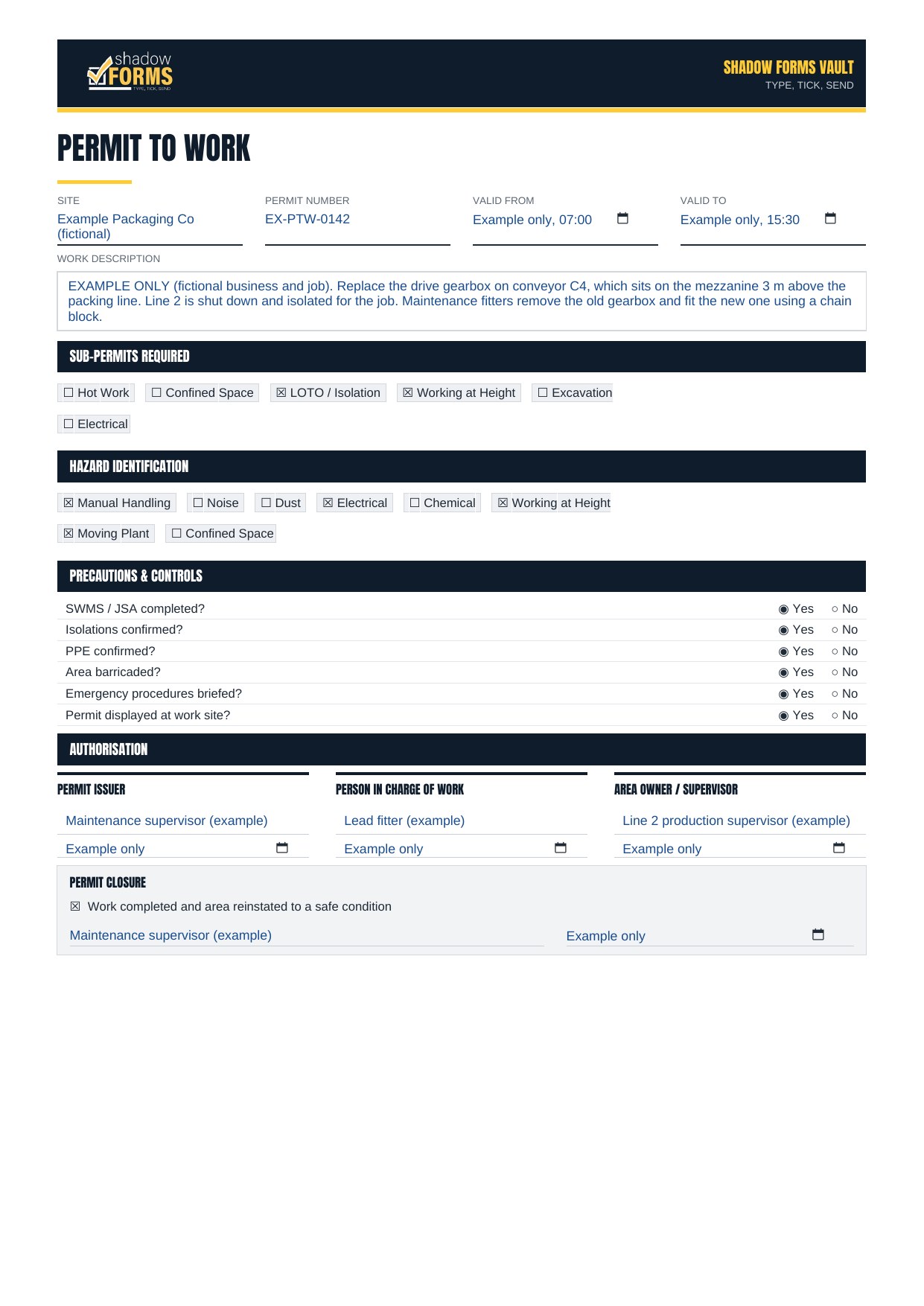
Your own permit must match the actual job and site, and follow your site's permit system.
This form is in the Shadow Forms app. Your team can fill it in on site, add photos and sign it, then send it straight to the office.
The PDF and Word versions are copies only. If you have your own branded version, or want this one adjusted to your business, we can add it to the app. Upload a form, or get in touch.
Doing hot work? Get the free hot work permit template.
Isolating plant? Get the free lockout tagout permit template.
WorkSafe Victoria requires permit to work systems for plant exposed to an electrical hazard, and confined space entry needs a written permit everywhere. For most other work, a permit is a way to control risk rather than a legal requirement, so check your regulator.
Safe Work Australia's major hazard facilities guide says permits should only be issued by qualified permit authorisers, and received by people trained in the permit system. SafeWork NSW says to get the permit from the supervisor when the risk assessment requires it.
A SWMS sets out how high risk construction work will be done safely. A permit to work authorises a specific job at a specific time and place, and is closed out when the work is done. Some jobs need both.
Safe Work Australia's guide says the rules for extending a permit beyond the shift it was issued on should be clearly set out. Many sites limit a permit to one shift.
Yes. It's already in the Shadow Forms app. If you have your own branded version, or want this one adjusted to your business, upload it on our Upload a form page or get in touch.
General information only, not legal advice. Check your state or territory regulator.
Send us your own forms and we'll show you exactly how they'd work in the app, no obligation.
Questions? Email us at info@neonroom.com.au