Last reviewed: November 2026
Want to fill this in on your phone? We can add it to the app.
Upload a form →A hot work permit controls welding, cutting, grinding and other work that makes sparks or heat, so it doesn't start a fire. It records the fire prevention checks, who is on fire watch, and the final area check after the work. Our free hot work permit template is a base template you fill in for your own site. Below is an example of it filled in for fictional welding and grinding on a food plant's production line. Download the blank template here:
Welding inside a tank or pit? You also need a confined space entry permit.
Hot work is covered by your WHS regulator, and outdoors it can also be restricted by your state's fire service on total fire ban days. We're not a regulator, so check both:
New South Wales: welding, grinding and gas cutting are not to be done in the open on a total fire ban day unless an exemption applies. See NSW RFS total fire ban rules
New South Wales: for workplace rules, see SafeWork NSW's welding code of practice
Victoria: welding, cutting and grinding in the open on a total fire ban day need a permit from CFA, FRV or DEECA, depending on where you are. See CFA total fire ban permits
Queensland: check your fire service's total fire ban rules as well as WorkSafe Queensland
South Australia: SafeWork SA
Western Australia: WorkSafe WA
Tasmania: WorkSafe Tasmania
Northern Territory: NT WorkSafe
Australian Capital Territory: WorkSafe ACT
The fire precautions standard for hot work is AS 1674.1:2025
Every job is different, but these are hazards that often get missed on hot work, with the kind of control the permit should show for each:
Sparks reaching combustibles out of sight, behind walls, through gaps or on the floor below: check all sides and levels, and cover or remove combustibles.
Fire starting after the job is finished: a fire watch during the work and for the set time afterwards, with a final area check.
Flammable vapours from tanks, drums or pipes that held fuel or solvents: clean, purge and gas test before any heat is applied.
Sprinklers or detectors turned off and forgotten: record any isolation on the permit and restore it before closing.
Gas cylinders leaking or getting hot: secure cylinders upright, check hoses and flashback arrestors, and keep cylinders away from the work.
Fumes from welding, especially galvanised or painted metal: extraction or ventilation, and respiratory protection where needed.
Burns and eye injuries to people nearby: welding screens, and an exclusion zone around the work.
Outdoor work on high fire danger days: check total fire ban rules and any permit conditions before starting.
Before work starts, check the permit doesn't have these gaps. Your site or insurer may look for more:
It doesn't say exactly where the hot work is, or what's on the other side of walls and floors.
No one is named as the fire watch, or the fire watch time after work isn't set.
There's no gas test recorded where flammable atmospheres are possible.
Fire protection that was isolated isn't recorded, or not restored at closure.
The final area check is ticked without a time or a name.
Example only, not for use as your own permit. This is the base template filled in for fictional welding and grinding on a food plant's production line, with a 60 minute fire watch. Click the page to enlarge it.
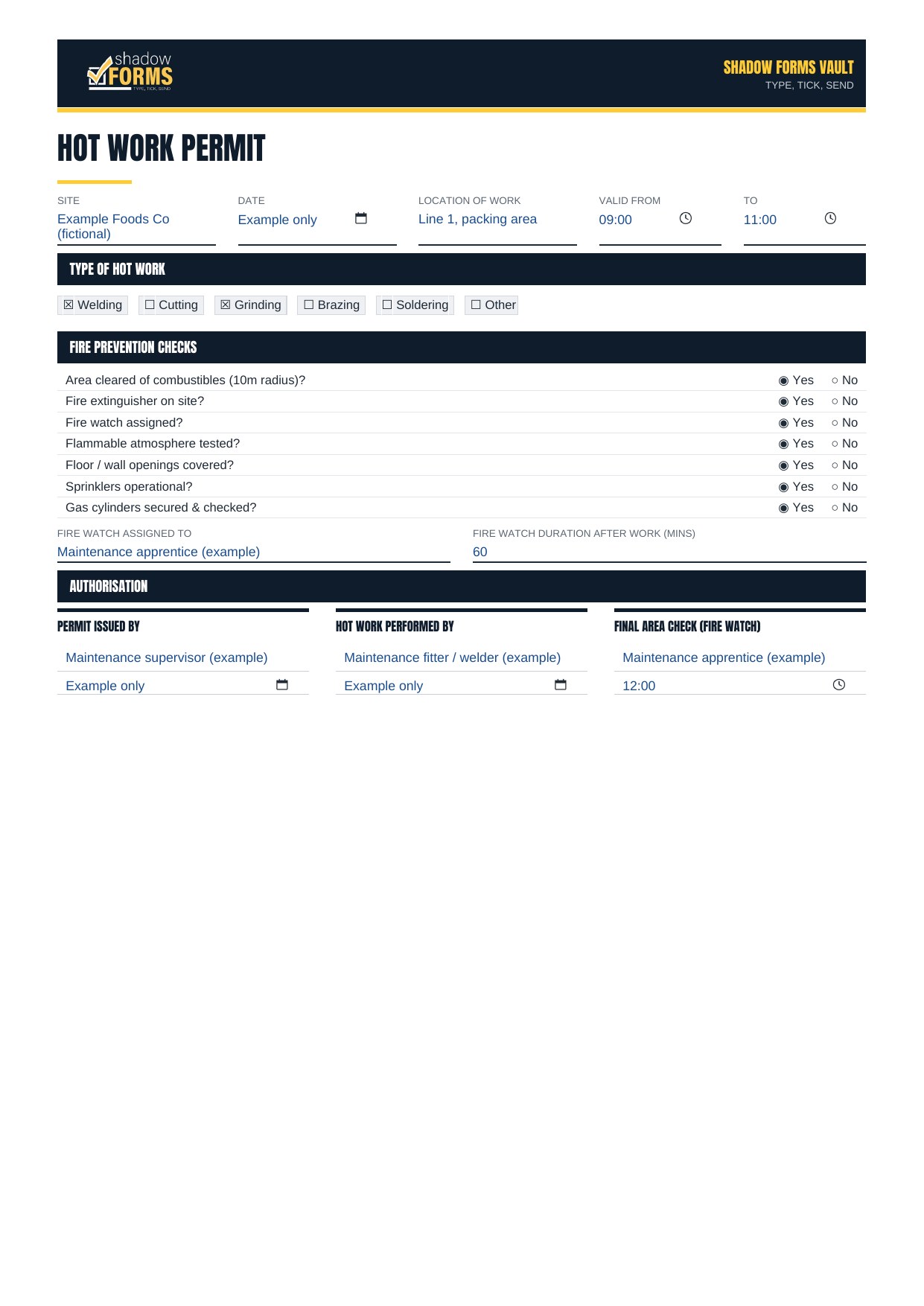
The 10 m clearance and 60 minute fire watch in this example aren't legal requirements. Set them from your site procedure, AS 1674.1 or your insurer.
This form is in the Shadow Forms app. Your team can fill it in on site, add photos and sign it, then send it straight to the office.
The PDF and Word versions are copies only. If you have your own branded version, or want this one adjusted to your business, we can add it to the app. Upload a form, or get in touch.
Running a bigger job? Get the free permit to work template.
Isolating plant? Get the free lockout tagout permit template.
SafeWork NSW's welding code says welding outside a confined space should follow documented procedures that include a hot work permit. Check your regulator and your insurer for what's expected where you work.
AS 1674.1:2025 covers fire precautions for welding and allied processes. It replaced the 1997 edition, which the NSW welding code still refers to.
There's no single legal figure. Set the time from your site procedure, AS 1674.1 or your insurer, and record it on the permit.
SafeWork NSW's welding code covers welding and allied processes such as cutting. Grinding, brazing, soldering and any work that makes sparks, flame or heat near combustibles is usually treated as hot work too.
Yes. It's already in the Shadow Forms app. If you have your own branded version, or want this one adjusted to your business, upload it on our Upload a form page or get in touch.
General information only, not legal advice. Check your state or territory regulator.
Send us your own forms and we'll show you exactly how they'd work in the app, no obligation.
Questions? Email us at info@neonroom.com.au